

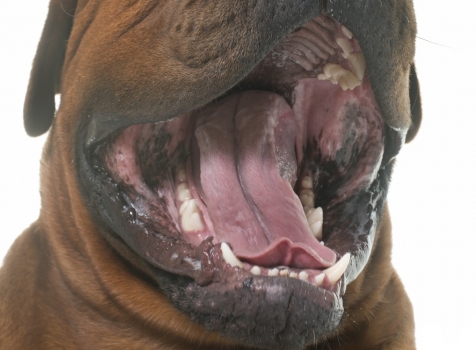
Teeth on Edge: Analyzing the Different Bites in Molossers
The business end of the dog is, of course, the bite.
And in many respects, a dog’s mouth is the corollary to a human’s hands. It is the body part that canines use to do their work, whether it is a herding dog nipping at the heels of a stubborn ewe, or a Greyhound swooping down to snatch up a fleeing hare.
Among Molosser breeds, with their wide and strong jaws, this powerful weapon encompasses all those roles — the Cane Corso in subduing cattle, or the Dogo Argentino latching on to the neck of an unlucky boar — as well the pursuit and disabling of human intruders.
Let’s look at the various kinds of occlusion — a fancy word that means how the teeth mesh together — and how those bites reflect the individual functions of the various Molosser breeds. Dentition, or the number of teeth (which in a complete bite totals 42, with 20 above and 22 below), is a different subject entirely.
Scissors Bite
While this is not a universally accepted bite among all Molossers, it is the most frequently seen among most breeds.
In the scissors bite, the lower incisors, or the bottom front teeth, slip inside and rest against the upper incisors.
This is the OG bite in dogs — wolves and other canine predators have scissors bites. And that makes sense, because the scissors bite is a slashing bite, extremely punishing and ideal for ripping through muscle and severing arteries. If you want your prey dead, the scissors bite is the canine occlusion of choice.

Wolves have scissors bites — all the better to chomp you with, my dear.
When there is too large a gap between the upper and lower incisors, this is referred to as an overbite or an overshot bite. Overbites are not functional because this displacement between the incisors also causes the canines (which are the holding teeth, or “fangs”) to be misplaced: Instead of those four teeth meshing together neatly, with the lower canine fitting neatly between the upper canine and outermost upper incisor, the lower canine pokes into the roof of the mouth.
Among AKC-recognized breeds, the Dogo Argentino, Boerboel, Mastiff and Neapolitan Mastiff all have scissors bites as their ideal. The Fila Brasiliero — which is not AKC recognized and likely never will be, given its distrust of humans — also should have a scissors bite.
The reason is simple, if not very pleasant: These breeds were not bred for holding, but rather for disabling their prey with crushing, tearing bites.
In the case of the Dogo, which was bred to hunt large game, including wild boar, the scissors bite is the most deadly bite when confronting such powerful and dangerous foes. When the Dogo latches on to the neck of its prey, its goal is not just to hold but also to kill.
As for the Boerboel, Mastiff and Neapolitan Mastiff, the scissor bite was effective for the same reason: It not only held a trespassing or threatening human, but could also immobilize permanently. This dispatching of prey goes back to their historical classification: In times past, true mastiffs with a small “M” also had a hunting function, acting as a large-boned, broad-mouthed hounds.
Level Bite
Also called a pinscher bite, the level bite means just what it says: The teeth are level. In this bite, the bottoms of the upper teeth and the tops of the bottom meet evenly, with no overlap.
This is not only a difficult mouth to breed, but also to maintain: Because the tips of the top teeth are always in contact with those of the bottom teeth, they grind downas the dog ages .

Level bites can be worn down with time.
The Bullmastiff standard says this is an ideal bite for the breed, but most dogs are undershot, which is certainly correct as well. That’s to be expected, given the amount of Bulldog blood in the Bullmastiff.
Undershot Bite
Called “prognasticism” in European countries — they love those big words — this refers to a lower jaw that is longer than the upper, resulting in bottom teeth that overlap those on top.
Given that there is some degree of Bulldog in most Molosser breeds — certainly the ones that we cover here at Modern Molosser — many, if not most standards are tolerant of an undershot bite. Of the breeds we’ve mentioned that ideally want a scissors bite, the Mastiff, Neapolitan Mastiff and Fila tolerate an undershot bite, the tighter the better.
The most undershot of all the Molossers is the Dogue de Bordeaux, which not coincidentally is also the most Bulldog-like. Its undershot bite is necessary for its “sour mug” expression; as a result, lack of an underbite is a disqualification for this French Molosser. (For a precise explanation of the other elements of that quintessential Dogue expression, see my video interview with Bas Bosch.)

It doesn't take too much experience to see the difference between these two Dogue heads. The dog top left severely lacks breed type, due to the absence of chin, which derives from the undershot bite. The dog at right, while still a puppy, already has the "sour mug" expression that is so fundamental to breed type. Credits: Above left, Dreamtime. Above right, Chelsea Conway.
But there can be too much of a good thing, and dogs whose tongues or teeth are visible when the mouth is closed are a bridge too far.

Undershot bites become problematic when they protrude too far. This excessive length is almost always accompanied by an undesirable narrowing of the jaw, as this fellow demonstrates.
Conversely, only the Dogo requires any degree of undershot bite to be a disqualification —even if it is a very tight underbite, what some would term “reverse scissors.” The reason for this insistence on a scissors bite is simple: Any other dental configuration would compromise the killing bite of this consummate big-game hunter.
The Boerboel standard allow for an undershot bite — but only to a certain point. This is to differentiate it from the Bullmastiff, which is its biggest genetic contributor.

Cane Corso Controversy
There is a big disconnect regarding occlusion in the AKC and FCI Corso standards. Both agree that the ideal bite is slightly undershot, but not in excess of .25 inch (AKC) or 5 mm (FCI), which comes out to about .2 inch.
But that’s about all they agree on when the comes to the mouth: The AKC standard says a level bite is just as correct as undershot; the FCI standard only tolerates a level bite, implying it is less than ideal. As for a scissors bite, the two standards exist in different universes: The AKC standard green-lights a scissors bite as long as the head and muzzle configurations are correct; the FCI standard considers a scissors bite to be a serious fault.
First, let’s give a nod to the rationale against a scissors bite in the Corso: That bite tends to narrow the muzzle, and the Corso needs a muzzle that is as wide at the end of the muzzle as it is at the base. So it’s rather rare to find a Corso with a scissors bite that has the correctly shaped muzzle, which needs not only to be wide but also deep: The lower jaw has to be long enough so that the profile of the muzzle is completely vertical. Again, hard enough to achieve with an undershot bite — very tricky with scissors. But, the AKC Corso standard says, if the muzzle proportions are correct on the outside, we’ll forgive what’s inside.

Bagheera della Murghese. Notice how flat the lateral face of her muzzle is. It is exceedingly difficult to achieve this correct muzzle with a scissors bite.
Another argument in favor of the scissors bite is that constantly breeding undershot to undershot results in severely protruding underjaws that surpass the quarter-inch limit imposed by the AKC standard. Some breeders say that breeding to a scissors — or level — bite every third or fourth generation keeps excessively undershot bites at bay.
When I was translating Claudio de Giuliani’s Cane Corso Italiano book, I was surprised to see some very prominent Italian judges second-guessing this wholesale rejection of scissors bites. While that hasn’t changed the FCI standard, it at least opens the door to conversation about the pros and cons.
Words of Caution
Not long ago, Corso fanciers in the U.S. were abuzz with news that a judge had disqualified a dog for being too undershot when the bite itself was perfectly fine. (Remember, in that breed, more than a quarter-inch undershot is a disqualification.) Photos from various angles were sent to me, and from what I could see (always a big caveat), the bite did not appear to be a disqualification.
But the confusion was understandable: When I check the amount of underbite on a breed where excessive underbite is a disqualification — such as in the Corso or the Boerboel — I look at the position of the incisors, or the front teeth between the canines. Since I can’t whip out a ruler and check the actual measurement, I imagine the width of a pencil, which is approximately a quarter-inch. Any wider, and I am comfortable calling that a disqualification.

Above left: A correctly undershot bite on a Cane Corso. Above right: If in doubt, check the bite on profile.
But if one looks at other areas of the Corso’s bite — say, the far edges of the bite, where the canines are — there can be a bit more space. That’s to be expected when you have a lower jaw that is supposed to be very wide and squared off: By contrast, the upper jaw is naturally somewhat rounded, so some gaps in the “corners” of the bite are perfectly normal. The best approach is to only check the distance between the incisors (again, the front teeth between the canines), and, if you want confirmation, check out the bite in profile.
Finally, remember that age can play a factor in assessing a bite: It’s well known that the lower jaw grows at a different — and usually slower — rate than the upper jaw. So sometimes, a puppy that appears to be slightly overshot will correct to a scissors bite by the time it is fully mature. (That is, if the canines are in the right place and not misaligned.) Conversely, if a dog is very undershot as a puppy, chances are that bite is only going to get even more undershot in adulthood.