


What breed is this? Does it matter? It's too short bodied, which is a problem in a number of Molosser breeds.
The Long and Short of It: Understanding Molosser Proportions
Most Molosser breeds — with the notable exception of the almost-square Bullmastiff — are supposed to have an outline that is longer than tall.
But many breeders find that achieving the correct proportions for their breed to be easier said than done. And, sometimes, even getting it said can be complicated.
So let’s try and break this down.
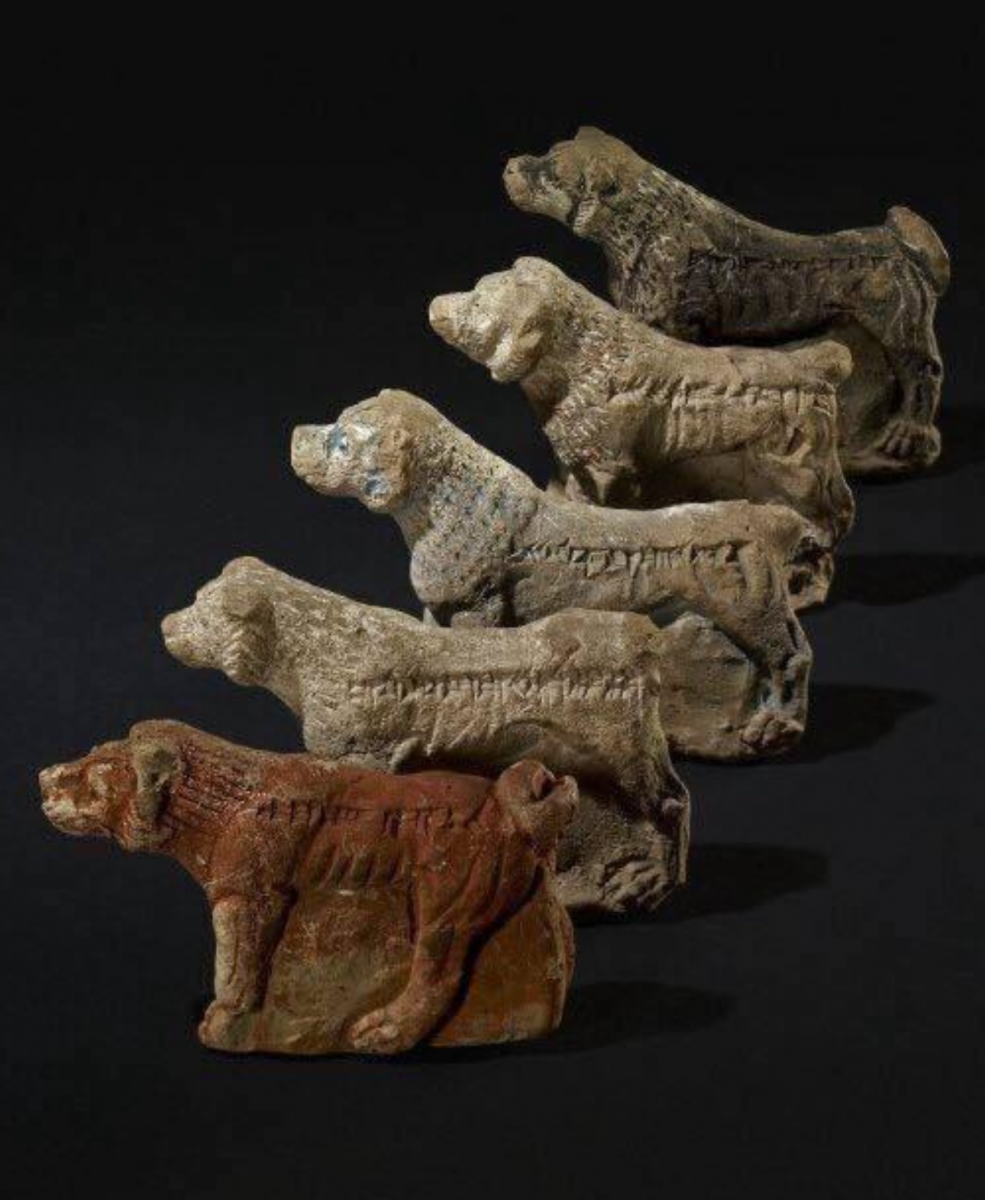
Assyrian dogs with names carved in them, circa 650 BCE — proof that varying lengths of body in dogs have been a reality for millennia. Source: British Museum.
Wither Must I Wander
Before we talk about proportions — specifically, height and length — let’s spell out exactly how we are measuring.
When it comes to height, there’s thankfully no debate about the precise point where we drop our plumb line. In dogs, as in horses, we measure from the withers — the area where the shoulder blade meets the topline. To further specify that measuring point, we are looking for the highest point of the shoulder blade. (This is the American Kennel Club’s official definition of the withers, found in its glossary of terms.) To locate the withers, run your hand down the dog’s neck and then feel for the projecting tops of those shoulder blades. That is the withers.
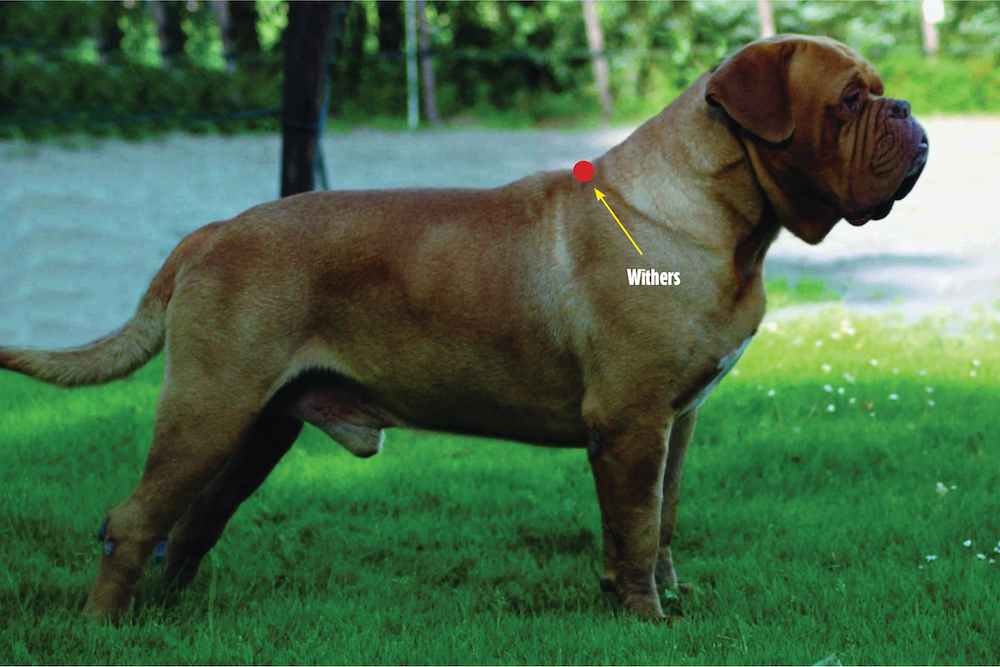
In case you don't know where the withers are, here's a map. This is also an excuse to revisit the famous Dogue de Bordeaux Multi-Ch. Moby de Legeane, who graced the ring two decades ago.
Measuring length is a bit trickier, first because there are multiple points you can measure from. While a handful of breeds ask for unconventional measuring points (like the English Cocker Spaniel, which measures from the withers to the set-on of the tail), we’ll focus on the three most common measuring points, which are the ones that apply to most Molossers.
Points Taken
Let’s start with the easiest point for measuring length, which is in the rear. It has a bunch of names: the point of buttocks, the pin bone or the ischiatic tuberosity. No matter what you call it, this landmark is the lowest part of the ischium, which makes up the pelvis. It protrudes just below the dog’s anus.
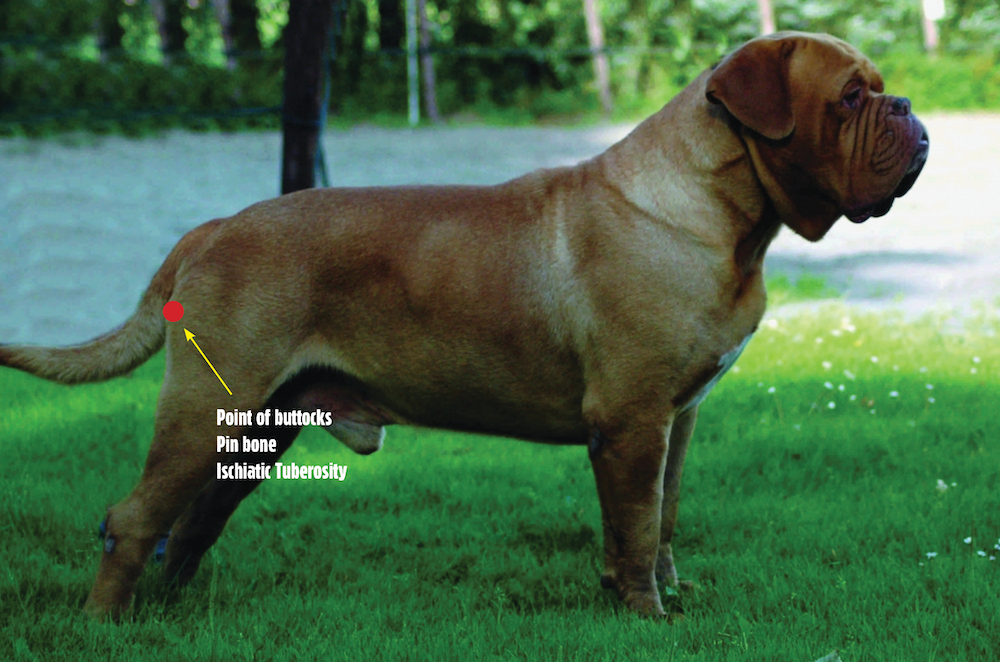
No matter what you call it — point of buttocks, pin bone or ischiatic tuberosity — this is the rear point from which one measures the length of a dog.
Heading to the front of the dog, there are two possible points from which to measure: They are the prosternum and the point of shoulder.
The prosternum is that protruding knob of bone at the front of the chest. Measuring from this point gives you a longer dog, because it’s the most forward-facing part of the dog’s trunk, and so farthest away from the point of buttocks. Typically, if you are measuring from the prosternum, that’s because the breed requires the prosternum to be well developed and prominent.
The second — and most common — measuring point at the front of the dog is the point of shoulder. Plenty of people are clueless about where this is. The point of shoulder is the point where the shoulder blade and the upper arm meet.
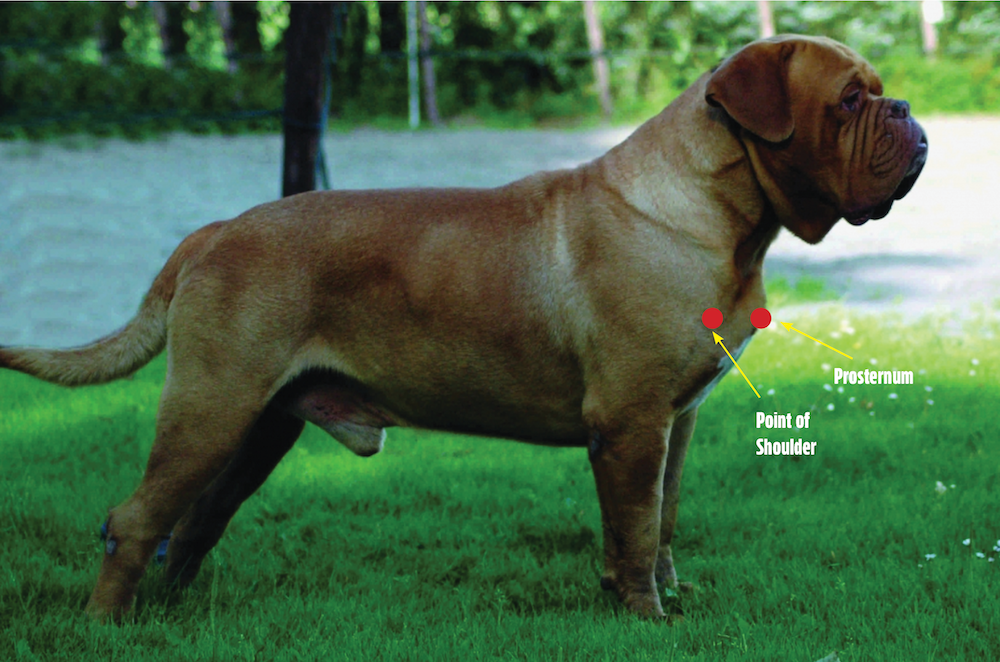
The point of shoulder and prosternum are in different positions. Because the prosternum is farther away from the point of buttocks, measuring from this point will give you a smaller percentage/shorter dog than if you measure from the point of shoulder.
Measuring from the point of shoulder can be challenging, because it assumes that the point of shoulder is in the right place. But what happens if you have a dog who has a faulty front assembly? Specifically, one that is forward set, with the legs under the neck (or — horrors! — head) rather than directly under the withers, which is where they are supposed to be? Then the point of shoulder is too forward set, and that will affect your measurement, resulting in a dog that measures shorter than intended.
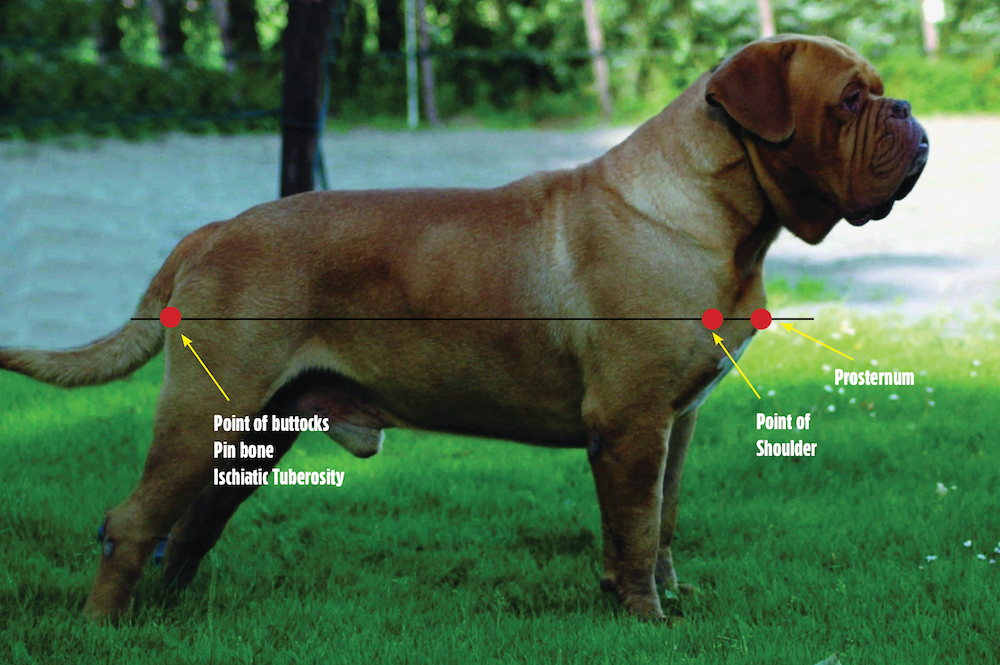
By the way, in the best-constructed dogs, these three horizontal points of measurement are all on the same plane.
Theory of Relativity
Frustratingly, many standards don’t specify which point you should measure from — the prosternum or the point of shoulder. And too often they don’t even give you a percentage for the relationship of height to length. Instead, they use relative terms like “off square” or “slightly longer than tall.”
Depending on breed, body proportions can range wildly, from taller than long to longer than tall. The most famous taller-than-long breed is the Azawakh, a North African sighthound that should be 10 percent taller than long, making it resemble a cereal box, or, famously, a suitcase set on its side. On the other end of the spectrum are the relatively lower-legged bichon and griffon breeds, which have the most generous measurement of 20 percent longer than tall. (And, not coincidentally, most of those breeds measure from the prosternum.)

Even from this angle, you can appreciate the verticality of the taller-than-long Azawakh. Photo thanks to my masterful mentors in the breed, Francesca Zampini and Patrizio Palliani of Azamour in Cerbara, Italy.
In between these extremes we have three measurements typically found in dog standards: square, off-square and slightly longer than tall.
“Square” is no problem: A square dog is equal in height and length. Sometimes a dog can have such a generous forechest and equally ample rear angulation that those protruding parts, front and rear, can visually elongate the dog. (Doberman Pinschers come to mind.) But when we measure from point of shoulder to point of buttock, and compare it to the height at the withers, the dog is indeed square.
Now we are left with that pesky “off square” and its cousin, “slightly longer than tall.” While there are exceptions that prove the rule, those who study and analyze standards soon see a pattern emerging: Those breeds described as “off square” are generally around 5 percent longer than tall. That is, they are almost square at first glance, as that small percentage is not always easy for the eye to register, especially if the viewer is not experienced.
“Slightly longer than tall,” by contrast, typically reflects a body that is 10 to 12 percent longer than tall. Sometimes this is expressed as a fraction rather than a percentage.
Again, it's important to remember that while this is a trend noted in standards, it is not a hard and fast rule. Plenty of standards contradict this, as you'll soon see.
Now that we have laid the groundwork, let’s take a look at some Molosser breeds that struggle with keeping their length of body.
Mastiff
We already discussed this in a previous story, but it bears repeating: The Mastiff is a rectangular breed, which means it should look significantly longer than tall. Reinforcing that is the fact that the standard says the Mastiff’s height should come from its depth of chest, not its length of leg. The Mastiff should also have a prominent and well-developed prosternum, which visually elongates the dog, pushing it beyond the 10 percent longer-than-tall measurement that is so commonplace in breed standards.
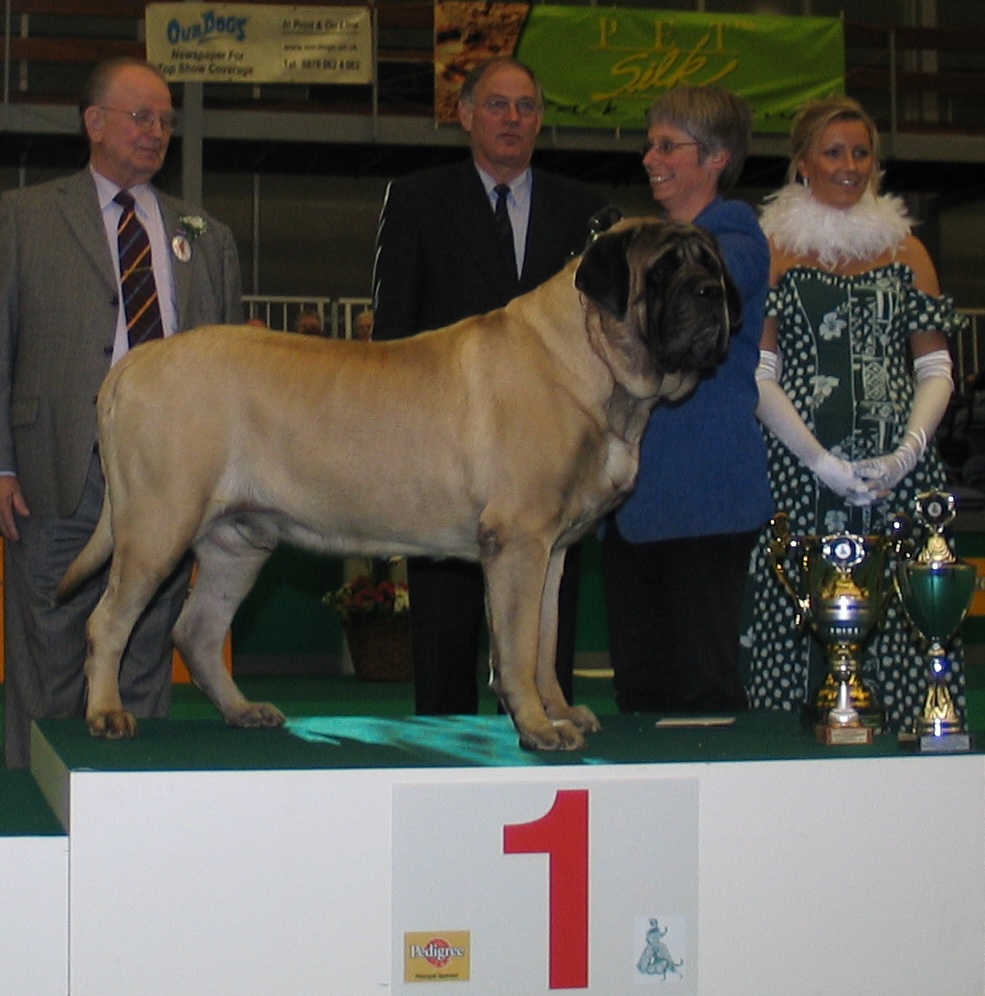
An excellent Mastiff with correct rectangular proportions, which are achieved thanks to a generous prosternum.
Judging a high-quality entry of Mastiffs recently, I kept toggling between two males I particularly liked. In the end, I chose the one with the longer body, as the other was a bit too square. Huge caveat here: That length of body should come from the length of ribcage and prominence of prosternum, and NEVER — can I say that again? NEVER — from the length of loin.
Neapolitan Mastiff
The Mastino is one of those breeds fortunate enough to have its length spelled out in its standard: According to the AKC standard, its length of body should be 10 to 15 percent greater than its height. That’s quite a spread, and may reflect the different styles within the breed — or different points of measurement (i.e. prosternum vs. point of shoulder).
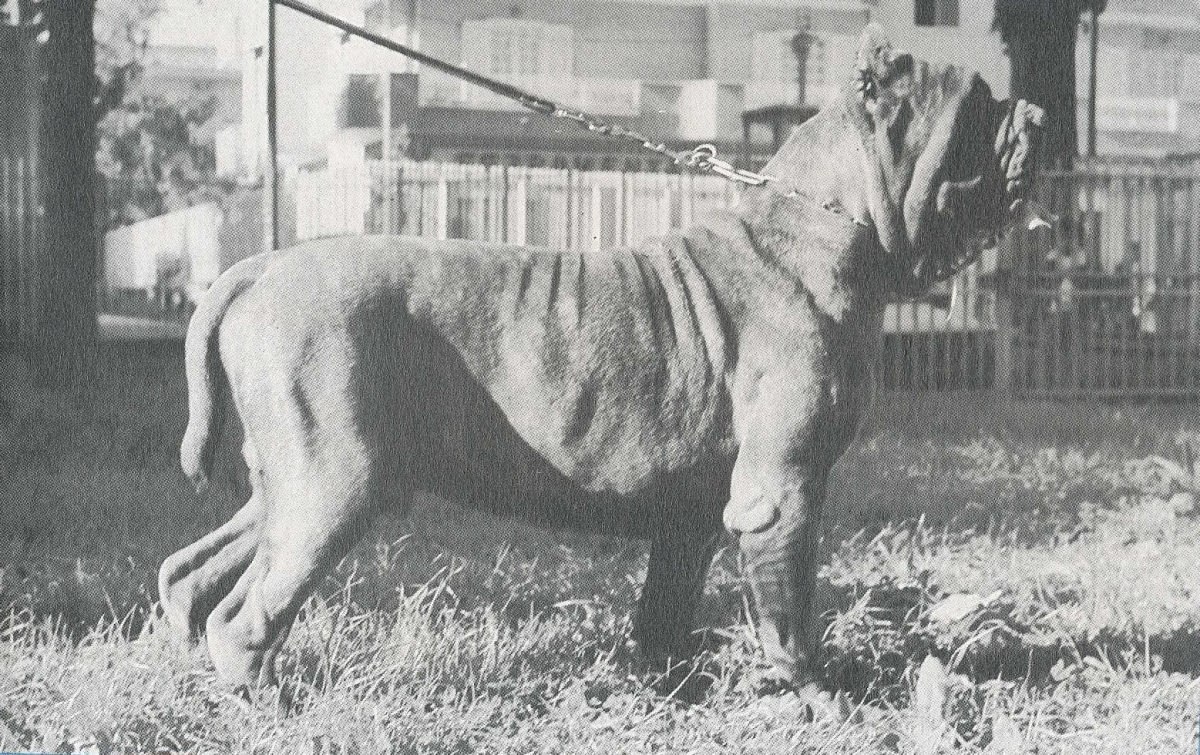
Italian Ch. Hatrim della Grotta Azzura— excellent longer-than-tall proportions.
The FCI standard emphasizes the importance of this generous length even more, saying simply: “The length of the body is 15% more than the height at the withers.”
Neapolitan Mastiffs do have a tendency to shorten up if this required length of body is not paid attention to. I have no idea where this squarer silhouette comes from, but it is a drag of the breed.
Cane Corso
In the Cane Corso, unfortunately, we see plenty of incorrectly proportioned dogs. And that is certainly caused in large part by the dizzying number of cross-breedings that took place during the breed’s development.
The Cane Corso’s AKC standard not only provides a percentage of length to height — it also specifies where to measure from to achieve the breed’s “rectangular” proportions: “The length of the dog, measured from the point of the shoulder to the point of buttock is approximately 10 percent greater than the height of the dog measured from the highest point of the shoulder to the ground.”
The FCI standard is far less specific in this regard, saying only: “The body is somewhat longer than the height at the withers. Sturdy built but not square.” The words “somewhat longer” and “not square” signal to me that the FCI standard has ample room to accommodate the AKC standard’s request for 10 percent longer than tall.
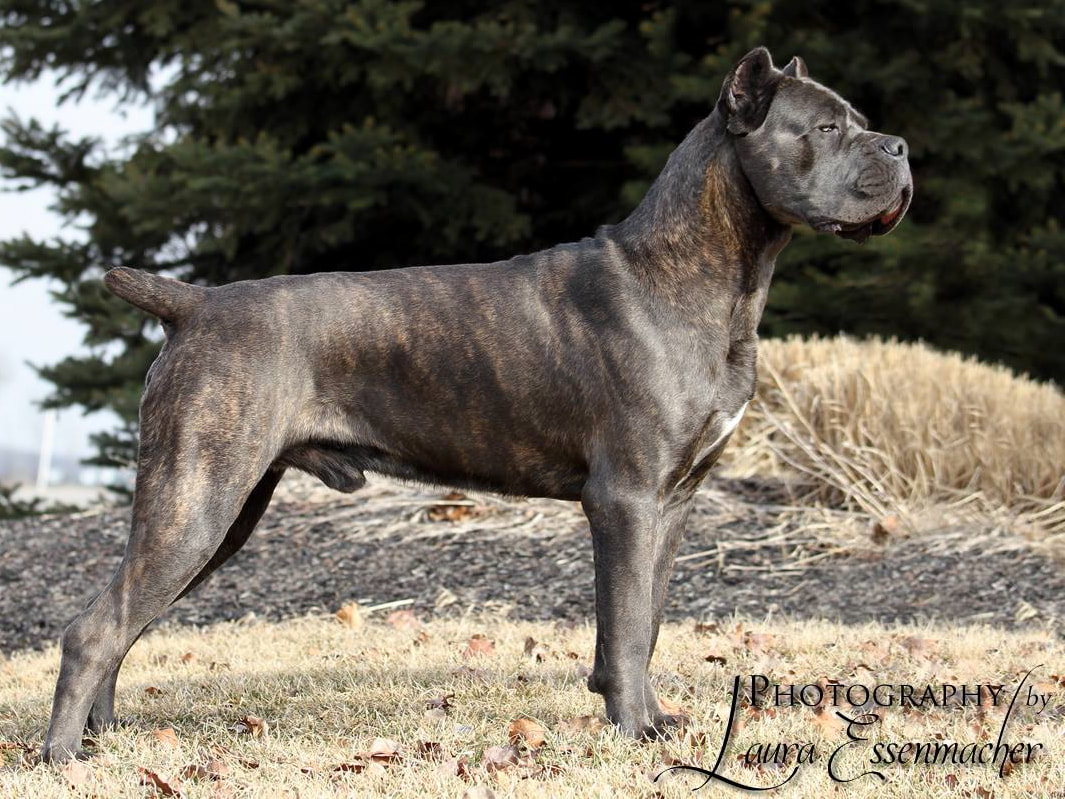
A correctly proportioned Corso with a strong, level back. Good luck finding that anywhere these days.
Being all-around working farmdogs, Corsos are supposed to excel at the trot. Trotting dogs are not square, because that restricted length makes it difficult for the dog to collect its legs neatly under its body, resulting in crabbing, overreaching and other movement errors. That said, the ocean of Boxer and Great Dane blood present in modern Corsos regularly results in square subjects washing up ashore in whelping boxes. (In case you didn’t know, both those breeds are supposed to be square.)
On the other end of the spectrum are the overly long dogs. These have become so ingrained in the breed that I have heard some prominent breeders say that the dogs can be as much as 20 percent longer than tall, which is nothing short of ridiculous.
Again, in the Cane Corso — as in most breeds that do not have specialized structure — the length of body should NEVER come from the loin, but rather from the run of rib.
Dogo Argentino
Like the Corso, the Dogo is a trotter, and his proportions — 10 percent longer than tall, which both the AKC and FCI standards agree on — makes perfect sense. The AKC standard goes on to note that the length of body should be measured from the point of the shoulder to the point of the buttock, which also tracks with all we’ve said so far. But what doesn’t add up is calling these proportions “slightly off square,” a phrase only used in the AKC standard. As I’ve noted earlier, “off square” is often used to describe breeds — the Portuguese Water Dog and Samoyed, among them — that are not so long bodied.
Semantics aside, no worries: That important 10 percent number in both standards makes it clear that these dogs should never appear square.

My 2023 Westminster Best of Breed winner illustrates the standard's request for a dog that is longer than tall.
Being Molossers that trot, Dogos (like Cane Corsos) often have high withers, which gives them additional surface area for soft-tissue attachment and so allows them to move with their heads up and out. But a high withers can also be a slippery slope in a measurable breed like the Dogo, which, unlike the Corso, has a disqualification for excessive height.
Dogue de Bordeaux
The FCI standard for the Dogue de Bordeaux is very specific about proportions, and the AKC standard, which took great pains to align with that of the mother country, followed suit: The length of body, measured from the point of shoulder to the point of buttock, is greater than the height at the withers, in the proportion of 11/10. If you do the math, that’s just a fraction shy of 10 percent longer than tall.
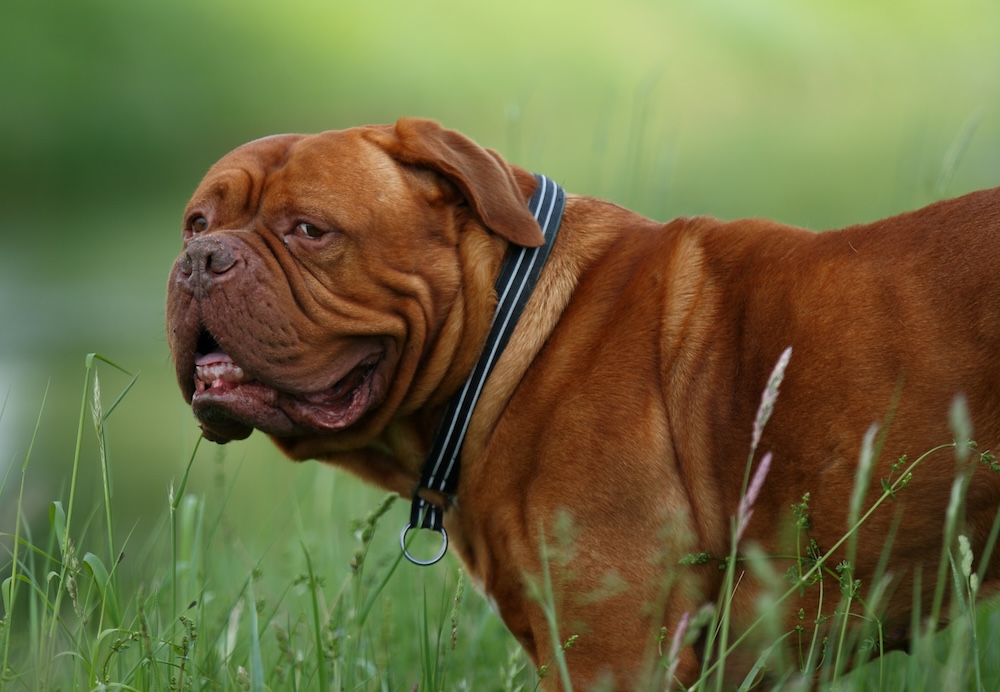
Dogues typically do not have high withers.
So, in theory, a Dogue shouldn’t be as long as a Neapolitan Mastiff, which makes sense when you consider that the former has a larger percentage of Bulldog blood. While the Bulldog standard doesn’t describe proportions, the breed should be relatively compact.
Boerboel
In this relatively newly recognized breed, we have all the information we need to measure correctly. According to the AKC standard, the breed should be longer than tall, and “the relation between the length and height should ideally be 10:9.”
When you convert to decimels, that comes out to 10 percent taller than long. Pretty standard as far as measurements go.
But keep reading, because the standard then notes that “Length of body is measured pro-sternum to farthest point of rump.” (The word “from” is missing in front of the word “prosternum” in the official standard posted online.)
That’s interesting, because in a dog with a well-developed prosternum, that would significantly reduce the length of the actual body, perhaps to almost square proportions. Given that the Boerboel is always fighting the influence of its main genetic contributor, the Bullmastiff, which is almost square, measuring from the prosternum seems counterintuitive to me.
How can we explain this? Here are a couple of thoughts:
The best Boerboels often have a very high withers, which increases the height of the dog significantly. And since length is always a percentage of height, that taller measuring point increases the permissible length as well.
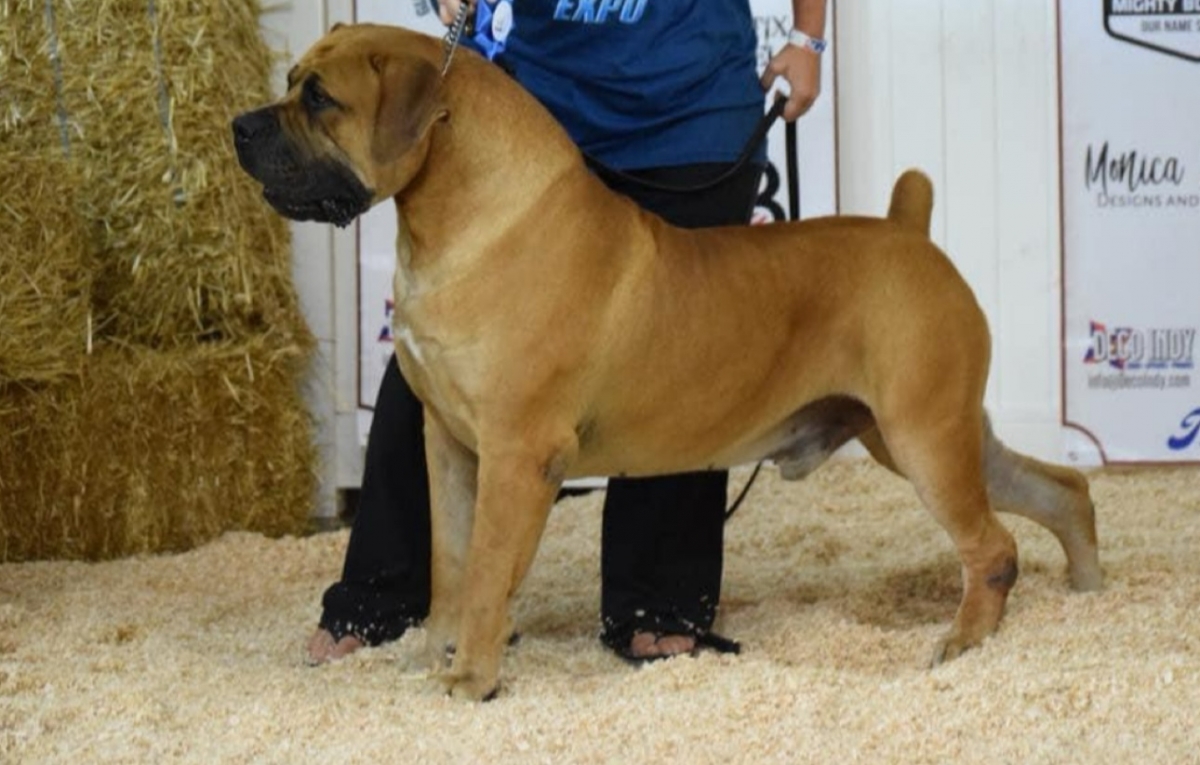
Many excellent-quality Boerboels have high withers. The additional inches afforded by this high stationing allows for a proportionally longer length of body.
Consulting other standards usually helps to clear up confusing or contradictory language, and that’s the case here: The standard approved by the South African Boerboel Breeders Society (SABBS) also notes that length should be measured from the prosternum, but it also gives a far more generous range of 10 to 15 percent. Though the SABBS illustration of the ideal Boerboel (below) appears much squarer and lower-withered than many dogs seen today, the higher-withered, longer-bodied dogs also fit into its wider range of length percentages.
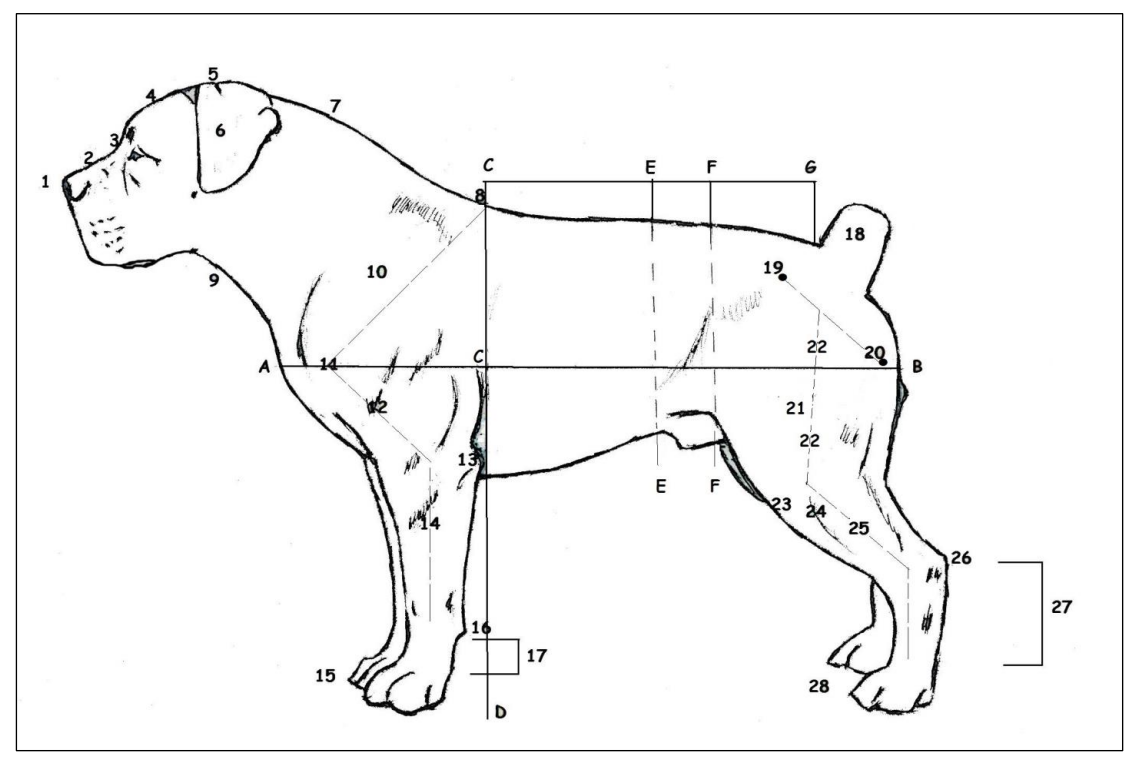
Illustration of the ideal Boerboel. Source: South African Boerboel Breeders Society.