


AI-generated image (obviously). Read on to see learn what this dog really looked like.
Mastiff on the Mayflower: A History Mystery
When it embarked on its 66-day journey to Plymouth, Massachusetts, in 1620, the Mayflower was crammed with all the supplies necessary to survive in a brave new world. That included oats, peas, mustard seed, “good cheese,” cider, skillets, platters, hoes, axes — and two dogs, one of them a mastiff.
That canine pair — the other was a spaniel — weren’t aboard for companionship, though they doubtless provided it as a byproduct of their presence. Four centuries ago, long before automation and globalization, dogs were indispensable tools for humans, helping them survive in often dangerous and inhospitable settings.
Modern dog breeders have lost no time in staking claim to these long-ago dogs, whose images were never recorded and whose presence was barely mentioned. In the past, the English Springer Spaniel Field Trial Association has suggested that the spaniel was one of their breed, and, correspondingly, because of its English origins, the Mastiff folks followed suit.
There is even a children’s book that tells the story of this mysterious Molosser. “The Mighty Mastiff of the Mayflower” by Peter Arenstam tells the fictional story of Grace, a female Mastiff who bonds with a young man on the long and difficult journey.
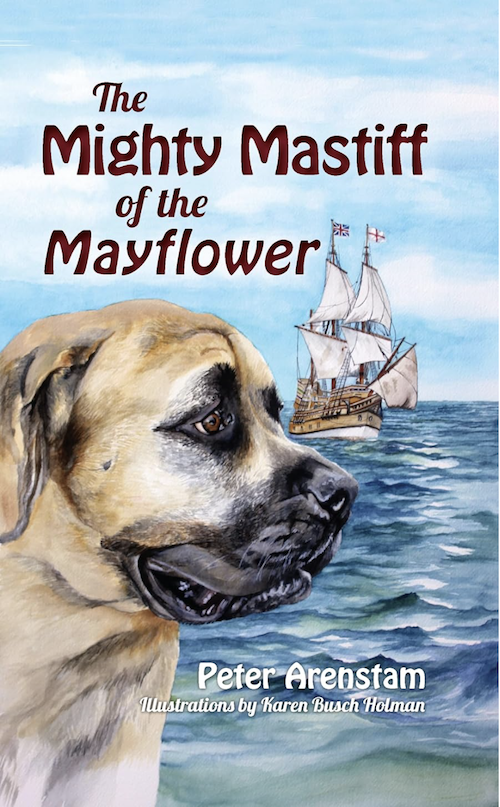
A fictional account of the Mayflower mastiff.
History is silent on the ultimate fate the Mayflower mastiff: While the dog’s name is unknown, Mourt’s Relation — written by colonist Edward Winslow and published in 1622 — describes her as a bitch. And we do know that both dogs, unlike so many of the ship’s human passengers, made it at least halfway through that first brutal New England winter.
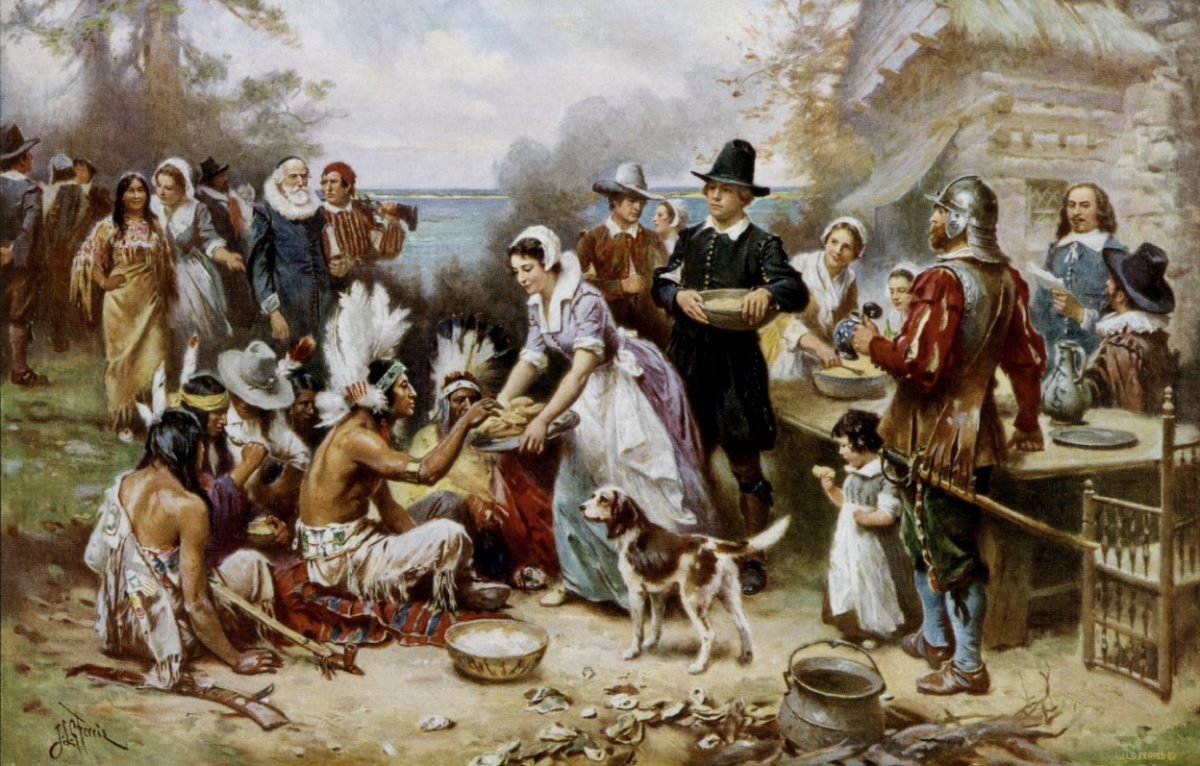
A spaniel appears in this painting of the first Thanksgiving by Jean Leon Gerome Ferris (1863–1930), but the mastiff is noticeably absent.
According to the account in Mourt’s Relation, the nameless mastiff was capable of the work she was bred for. In mid-January 1621, John Goodman and Peter Brown were cutting thatch for the houses they were building when they wandered off around noontime to have lunch with the dogs. The foursome stopped at a nearby lake, where the dogs noticed a huge deer and gave chase. Despite the men’s constant calls, the dogs did not respond. By the time Goodman and Brown eventually found their wayward canines, they were lost, and the two resigned themselves to spending the night without proper clothes or any provisions.
“When it drew to night they were much perplexed, for they could find neither harbor nor meat, but, in frost and snow were forced to make the earth their bed and the element their covering,” the book recounts. “And another thing did very much terrify them; they heard, as they thought, two lions roaring exceedingly for a long time together, and a third, that they thought was very near them.”
Fearing an attack, they placed themselves at the base of a tree, holding the bitch by the collar so she would not run and confront the source of the roaring.
Thankfully, “the wild beasts came not,” and when morning dawned the men returned to Plymouth colony, frostbitten to the point that John Goodman’s shoes had to be cut off his feet.
Little more than a week later, Goodman was walking the spaniel, trying to rid himself of his ensuing lameness, when two wolves chased the dog. (Presumably, the mastiff had been left behind.) Seeking shelter, the clever spaniel ran between the legs of Goodman, who threw a stick at the wolves. Persistent, they returned, and after watching Goodman brandish a fence board at them, the pair eventually took their leave.
The Trailblazers
While the Mayflower mastiff is perhaps the most famous of her breed to reach these shores in the 17th Century, she was not the first. Predating her by almost two decades were a pair of mastiffs that landed in New England in 1603, accompanying British explorer Martin Pring, who surveyed Maine, New Hampshire and Cape Cod looking for sassafras trees to harvest and export.
We know the names of these two dogs — Gallant and Foole — as well as the fact that they were let loose to terrorize the Algonquin-speaking Abenaki people: "… when we would be rid of the Savages company wee would let loose the Mastives,” Pring wrote, “and suddenly without cry[ing out] they would flee away.” As for the size of the dogs, he noted one was able to “carrie a halfe-pike in his mouth.” A half-pike, or spontoon, was a polearm that measured from six to almost eight feet long.

A scene from Pring's travels: "Indians dance round an English Boy who was playing on a gittern 1603." A gittern is the lute-like forerunner of the modern guitar. Note the mastiff at left.
All this begs the ultimate question: How big were these mastiffs, and what resemblance did they have to the dogs of today?
While we can’t know for sure, the probable answer is that they were not as massive as a modern-day Mastiff, very likely looking more like beefy Great Danes.
Col. David Hancock, that oftentimes contrarian canine historian, points out repeatedly — and exasperatedly — that the true definition of a mastiff (with a little “m”) is that of a broad-mouthed hound. Certainly a dog of that description could handily carry a narrow but heavy object like a half-pike, but would also be athletic enough to pursue a mature buck, as the Mayflower mastiff did.
“Our Mastiff was once revered all over northern Europe as a hunting dog: the Englische Dogge,” Hancock wrote. “It was a powerful, strong-headed, active, agile heavy hound, used to close with quarry and seize it for the accompanying hunters. It was not a giant sloth, but a mighty canine athlete.”

Lithograph of an "Englische Dogge" by Carl Joseph Brodtmann, published 1827. Molosser in head, the dog was also quite hound-like in body.
Though the ultimate fate of the Mayflower mastiff is unknown, her reason for being aboard that history-making ship is unquestionable. Thanks to its fervent protective instinct, the mastiff was the perfect canine to accompany those 100-odd Pilgrims in search of a new home — and in fear of what threats they might find there. And it’s that very same unwavering vigilance that attracts Mastiff lovers to the breed even today — no matter what exterior package it comes wrapped in.